

Table of Contents
- What Decides Whether Print-on-Demand Clothes Are Quality
- Print-on-Demand Clothing Materials: Blanks, Fabric Weight, and Stitching
- DTG vs. Screen Printing Durability: Which Print Method Lasts
- How to Wash Printed Shirts So the Design Survives
- The Print-on-Demand Sample Order: A Repeatable Quality Test
- Comparing Print-on-Demand Providers and Quality Control
- Pros and Cons: Are Print on Demand Clothes Quality Enough for Your Brand?
- Conclusion: Wear Your Strength, Verify the Quality
- Frequently Asked Questions
Last Updated: October 12, 2026
What Decides Whether Print-on-Demand Clothes Are Quality
Print-on-demand clothes are quality when three things hold up: the blank garment, the print method, and the provider's quality control. Get all three right and a POD shirt feels like retail. Miss one and it feels like a giveaway.
At JACKED N TAN, we sell print-on-demand apparel built on Printful, so we have a stake in this answer. We also know the frustration behind the question.
Here is the honest version: print-on-demand quality is not a coin flip. It is a set of checkable details.
Print-on-Demand Clothing Materials: Blanks, Fabric Weight, and Stitching
Print-on-demand clothing materials determine the ceiling on quality. A great print on a thin, poorly stitched blank still feels cheap. A solid blank with a decent print feels premium.
How Fabric Composition and Weight Change Feel and Performance
Two numbers tell you most of what you need to know: fiber content and fabric weight.
- 100% ring-spun cotton: soft, breathable, holds print well. Our short-sleeve tee uses it.
- Cotton-poly blends: less shrinkage, better shape retention after washing. Our hoodie is 50% pre-shrunk cotton, 50% polyester.
- Heavyweight knits: resist stretching at the neck and hem during training.
Weight matters too. Lightweight shirts show every fold and cling during a lift. Mid-to-heavyweight knits hold their shape and drape better.
Finishing Details That Separate Retail Quality From Cheap Blanks
Finishing is where cheap blanks expose themselves. Check these before you judge a garment:
- Double-needle stitching at the collar, shoulders, armholes, cuffs, and hem
- Shoulder-to-shoulder taping, which stops the neckline from stretching
- Quarter-turned body panels, which prevent a crease down the center
- Rib-knit cuffs and waistbands with spandex for recovery
Our unisex hoodie carries all four. That is not marketing talk. It is the difference between a hoodie that survives a training block and one that sags by month two.

DTG vs. Screen Printing Durability: Which Print Method Lasts
Direct-to-garment (DTG) printing lasts roughly as long as the garment when washed inside out in cold water and dried low. Screen printing outlasts DTG on heavy daily wear, but only pays off at higher order volumes.
Here is the trade-off most sellers skip:
- DTG: no minimums, full-color detail, softer hand feel. Best for small runs and complex art.
- Screen printing: thickest ink deposit, longest life on high-wear items. Setup cost per color makes small runs expensive.
- DTF: durable and stretchy, good on blends and odd fabrics.
- Sublimation: permanent, but only bonds to polyester. It will not work on 100% cotton.
- Embroidery: the most durable option for logos, with no cracking risk at all.
How DTG, DTF, Sublimation, and Embroidery Compare on the Same Garment
| Method | Best Fabric | Durability | Best For |
|---|---|---|---|
| DTG | 100% cotton | Good with proper wash care | Small runs, detailed art |
| Screen print | Cotton, blends | Highest on daily wear | Bulk orders, bold designs |
| DTF | Blends, cotton | High, stretches with fabric | Stretch fabrics, odd materials |
| Sublimation | Polyester only | Permanent | All-over prints on poly |
| Embroidery | Most fabrics | Highest | Logos, caps, small text |
The mistake we see most: brands pick a method for price, then blame the provider when the print fades. Match the method to the garment and the use case first.
How to Wash Printed Shirts So the Design Survives
Wash printed shirts inside out in cold water, skip the dryer or use low heat, and never iron directly on the graphic. These three habits prevent most print cracking and fading.
Print durability is mostly a care problem, not a printing problem. A DTG print that fails in ten washes usually failed because of heat, friction, or harsh detergent. But "care problem" is not a useful answer on its own. Buyers want to know which failure they are looking at and what caused it.
- Cracking: the ink film loses elasticity and splits along the design's stress lines. Caused by high dryer heat and by stretching a print that has already cured stiff. DTG and screen prints crack; sublimation and embroidery do not.
- Fading: pigment breaks down from UV exposure and repeated hot-water washing. Most visible on dark garments with light ink. Cold water and line drying slow it dramatically.
- Peeling: the ink layer separates from the fabric, usually at the edges of the design first. Caused by under-curing at the printer or by fabric softener residue breaking the bond. Peeling is a production defect more often than a care defect.
- Shrinkage: the blank, not the print, shrinks. Cotton-rich garments can lose length and width on the first hot wash. Pre-shrunk cotton-poly blends shrink far less. This is why a 50/50 blend often outlasts a 100% cotton tee in fit.
A Wash-Test Protocol You Can Run on Any Sample
Do not judge a print out of the bag. Run this protocol on one sample before you commit to a run:
- Wash the garment inside out in cold water on a gentle cycle, with a normal amount of detergent and no fabric softener.
- Tumble dry low, or hang dry. Record which you chose.
- Repeat for five cycles total, checking the print after each one.
- After the fifth cycle, inspect for cracking, fading, peeling, and measure the garment against its original size to check shrinkage.
- Stretch the print gently across its widest point. A healthy print returns to shape. A failing print stays distorted or splits.
A print that passes five cycles with no cracking, no edge lifting, and less than a quarter-inch of shrinkage is a print you can sell with confidence. A print that fails at cycle two or three is a production problem, not a customer problem.
- Turn the garment inside out before washing
- Wash cold on a gentle cycle
- Skip fabric softener, which breaks down the print bond
- Tumble dry low, or hang dry
- Iron inside out, never on the design
The Print-on-Demand Sample Order: A Repeatable Quality Test
Order one sample before you commit to a run. A sample order costs a little and tells you more than any product page photo ever will.
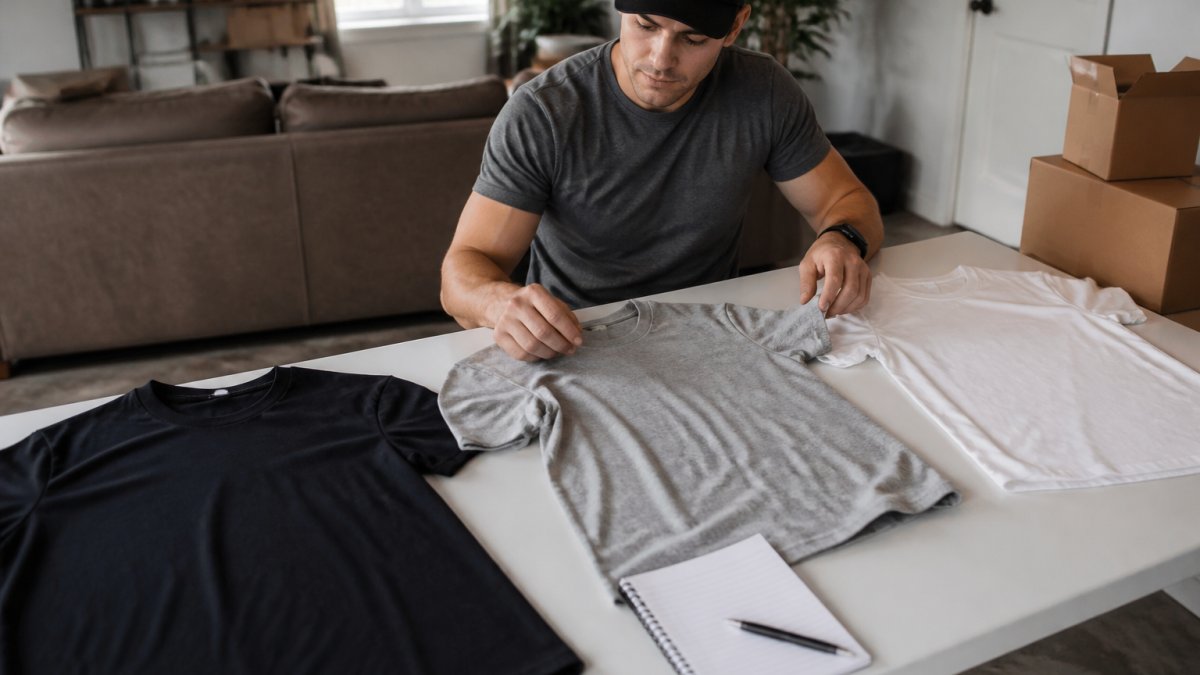
Order the exact garment, color, and size you plan to sell. Then put it through the same routine a customer would. Wash it, wear it, stretch it. Judge it after five washes, not out of the bag.
A Practical Checklist for Judging a Sample Before You Commit
Run this checklist on every sample before you scale:
- Print is centered and straight, with no misalignment
- Colors match your design file, with no dulling or banding
- Fabric weight feels right for the price you plan to charge
- Stitching is even at collar, cuffs, and hem
- Neckline springs back after you stretch it
- No chemical or vinegar smell out of the bag
- Print survives five washes inside out in cold water
- Sizing matches the published size chart
If a sample fails two or more of these, switch providers before you order in bulk.
Comparing Print-on-Demand Providers and Quality Control
Provider quality control is the variable most sellers ignore. Two providers can print the same file on the same blank and deliver different results. The reason is mechanical: blanks are sourced from different mills, presses run at different temperatures and dwell times, and fulfillment is split across multiple facilities.
So what separates a good provider from a weak one? Score them on these six criteria instead of trusting a homepage.
- Blank sourcing transparency: Does the provider name the mill or brand of the blank (for example, a specific ring-spun cotton tee) or does it hide behind "premium cotton"? Named blanks are repeatable. Unnamed blanks are not.
- Published specs: Fabric weight in ounces per square yard, fiber content, and a real size chart with chest and body-length measurements. If the spec sheet is missing, you cannot predict fit or feel.
- Print method by product: DTG on a 100% cotton tee is standard. DTG on a 50/50 blend behaves differently. Check which method the provider uses per product, not just per brand.
- Facility footprint: Ask how many fulfillment locations handle your product. More locations means more variance. If you can, request that orders route from a single facility.
- Reorder accuracy: The second order should match the first in color, placement, and hand feel. This is the single most predictive test of a provider.
- Misprint and return policy: A real policy states the window, the evidence required (photos of the defect), and whether they reprint or refund. A provider that dodges the question does not have a process.
A Provider Scorecard You Can Fill Out in One Afternoon
Rate each provider from 1 to 5 on the six criteria above. Anything scoring below 4 on blank sourcing transparency or reorder accuracy is a risk to scale with, regardless of price.
Ask one question before you commit: how do you handle a misprint? A provider with a clear answer has a process. A provider who dodges the question does not.
We chose Printful as our print-on-demand partner because it publishes garment specs and holds production standards across facilities.
Pros and Cons: Are Print on Demand Clothes Quality Enough for Your Brand?
Are print on demand clothes quality enough? Yes, if you pick the right blank, match the print method to the garment, and test before you scale. No, if you chase the cheapest option and skip quality control.
Pros:
- No inventory risk, so you can test designs without upfront stock
- Access to quality blanks without buying in bulk
- Easy to add sizes, colors, and new designs
- Low-risk way to launch a clothing brand
Cons:
- Per-unit cost is higher than bulk screen printing
- Quality varies by provider, facility, and batch
- Less control over production timing
- Print durability depends on the method and the buyer's wash care
Conclusion: Wear Your Strength, Verify the Quality
The gap between a cheap POD shirt and a retail-quality one comes down to three checks: the blank, the print method, and the provider's consistency. Run the sample checklist, wash the sample five times, and judge the result. That is the whole test.
At JACKED N TAN, we build our gear on that standard. Our Unisex Hoodie uses a 50/50 pre-shrunk cotton-poly blend with double-needle stitching and a double-lined hood. Our Short-Sleeve Unisex T-Shirt is 100% ring-spun cotton with shoulder-to-shoulder taping.

SHOP THE DROP and wear your strength.
Frequently Asked Questions
Are print on demand clothes good quality?
They can be, but quality depends on the blank garment, the print method, and the provider's quality control. A 100% ring-spun cotton tee with double-needle stitching and a DTG print holds up far better than a thin, poorly stitched blank. Always order a sample first and check fabric weight, stitching, and print vibrancy before judging a whole catalog.
How long do print on demand shirts last?
With proper care, a well-made print-on-demand shirt can last through 50 or more washes without major fading or cracking. Longevity comes down to print method and washing habits. Turn the shirt inside out, wash cold, and tumble dry low.
Does print on demand printing fade after washing?
It can fade if you wash with hot water, use harsh detergent, or dry on high heat. To protect the print, wash inside out in cold water and skip the dryer or use low heat. A sample order lets you wash-test a shirt before committing to a full run.
Is print on demand clothing durable enough for workouts?
Yes, if you choose the right garment. Look for pre-shrunk cotton or cotton-poly blends with double-needle stitching and a mid-to-heavyweight fabric. A 100% ring-spun cotton tank or a 50/50 hoodie handles gym use well. Avoid ultra-thin blanks that pill or lose shape. Wash cold and air dry to extend the life of both fabric and print.